
Screaming Frog SEO Spider is a desktop website crawler built by Screaming Frog Ltd, a UK search agency founded in 2010 and based in Henley-on-Thames. It sits in the SEO-tools category alongside Semrush, Ahrefs, SE Ranking, and Moz, but it occupies a different position within it: where those platforms are subscription data services built on keyword databases and backlink indexes, Screaming Frog is a measurement instrument. It crawls a website the way a search engine does, on the user’s own machine, and reports what it finds across more than 300 technical SEO checks. It optimizes for one thing: crawl data an SEO can treat as ground truth.
The tool has become the closest thing technical SEO has to a default. Its licensing model is unusual for the category, a flat $279 per year per user with a genuinely functional free tier, and its 2026 releases have pushed it somewhere unexpected for a fifteen-year-old desktop application: version 24 shipped an MCP server that lets AI assistants run, analyse, and export crawls through natural language. This review covers what the crawler actually delivers, how the SEO-tools rubric applies to a tool that measures rather than models, and where the desktop format and learning curve remain the honest costs of entry. All pricing and release details were verified directly against Screaming Frog’s own site and release documentation.
The most trusted measurement instrument in technical SEO at a price no suite approaches, held below its data score only by a dense interface and a learning curve built for practitioners rather than beginners.
Technical SEOs, agencies, and in-house teams who need deep site audits, migration checks, and crawl data they can treat as ground truth.
You need keyword research, rank tracking, or backlink data in the same tool, prefer a cloud product, or are new to SEO and want a gentle interface.
This review draws on daily first-hand use of Screaming Frog in live technical SEO work, supported by the vendor’s official documentation, pricing pages, FAQ, and release notes, all verified directly against Screaming Frog’s own site, and by recurring user consensus across G2, Capterra, TrustRadius, and practitioner communities. Where a judgment rests on first-hand experience it is stated as such; areas outside our direct use, including crawl behaviour on hardware configurations we have not run and long-run enterprise deployments, are assessed through documentation and consensus rather than assumption. Last reviewed: July 2026.
What’s New in 2026
The 2026 releases are the most consequential in years for a product with a famously steady cadence.
- MCP server. Version 24.0, released in May 2026, added a Model Context Protocol server that lets AI assistants such as Claude run crawls, analyse and manipulate results, and export data through natural language. Not every feature is supported yet, list mode among them, but the vendor has committed to extending coverage based on user feedback.
- Auto Compare Crawls. Scheduled and command-line crawls can now automatically compare the last two crawls in a project, surfacing every change since the previous run without opening the crawl.
- Monitoring by email. Crawl-completion notifications now include a full issues table, comparison changes when auto-compare is enabled, and the option to send export files as attachments, which turns the crawler into a lightweight monitoring system for stakeholders and developers.
- Uncrawlable link detection. A new filter surfaces links coded in ways that do not conform to Google’s link best practices, such as spans or divs carrying href attributes and JavaScript-only handlers.
- AI integration maturity. The direct integrations with OpenAI, Gemini, and Ollama gained live model validation, system-wide prompts, and token-usage reporting, building on the semantic similarity analysis and content cluster visualisations introduced in version 22.
- Currency adjustment, not a price rise. In May 2025 Screaming Frog adjusted non-GBP pricing to $279 and €245 to reflect exchange-rate movement. The base price of £199 has not changed since 2023, and the company notes only two price increases in the fifteen years since launch.
- Log File Analyser 7.0. The companion product for server-log analysis, licensed separately, received a major version update alongside the Spider.
Software Overview
Screaming Frog SEO Spider is a desktop application for Windows, macOS, and Linux that crawls websites the way Googlebot does, discovering links breadth-first through the HTML and optionally rendering pages in headless Chromium to see what JavaScript builds. A crawl surfaces more than 300 issues, warnings, and opportunities across response codes, redirects, metadata, duplicate content, structured data, accessibility, and site architecture, each with an in-app explanation and estimated priority. A hybrid storage engine lets it save crawl data to disk, which is how a desktop tool handles sites that run into the millions of URLs, hardware permitting. The free version crawls up to 500 URLs with core auditing; the licence removes the limit and unlocks configuration, saved crawls, JavaScript rendering, custom extraction, scheduling, and every integration. What it deliberately does not do is equally defining: there is no keyword database, no rank tracker, and no backlink index. Those live in the platforms this series has already reviewed, several of which Screaming Frog connects to directly.
- ✓Crawl data widely treated as the most accurate in the category, directly measured rather than modeled, with JavaScript rendering that mirrors how Google sees a page
- ✓Exceptional value at $279 per year for unlimited crawling, with only two price increases in fifteen years
- ✓The deepest technical audit feature set available, covering more than 300 issues plus custom extraction and custom JavaScript
- ✓First-mover MCP integration that lets AI assistants run, analyse, and export crawls in natural language
- ✓A genuinely useful free version covering 500 URLs per crawl, with no signup or email capture required
- −No keyword research, rank tracking, or backlink index of its own, so it cannot serve as a complete SEO stack
- −A dated, dense interface with a steep learning curve that user consensus consistently flags for beginners
- −Desktop-only delivery, with crawl capacity dependent on the user’s own hardware, memory, and storage configuration
- −Per-user annual licensing with no monthly option, and the tool reverts to the restricted free version when a licence expires
- −Direct support runs through email and tickets only, with no live chat or phone channel
The Trade-Off
The single exchange Screaming Frog asks a buyer to make is completeness in return for precision. You get the most trustworthy crawl data in the category at a price that barely registers against suite subscriptions, and in return you accept that the tool answers only technical and on-page questions, runs on your own hardware, and expects you to already know what a canonical tag or a hreflang error is. For a practitioner, that exchange is close to free. For someone who wants one tool to plan keywords, track rankings, analyse links, and audit a site, it is not an exchange at all: Screaming Frog is a component of a stack, not a stack.
Who It’s Best For
Screaming Frog fits technical SEOs, agencies, and in-house teams for whom site audits, migration validation, and structural analysis are recurring work, and who want crawl output they can hand to a developer without caveats. It suits consultants who audit many different sites, since licensing has no per-site limits, and teams already paying for Semrush, Ahrefs, or SE Ranking who need deeper crawling than any suite’s built-in audit provides. The new MCP server adds a further audience: teams building AI-assisted audit workflows who want a crawler their assistant can drive directly.
Who Should Look Elsewhere
Anyone who needs keyword research, rank tracking, or backlink analysis in the same product should start with the full platforms reviewed earlier in this series, since Screaming Frog provides none of the three. Beginners will find the interface and configuration surface genuinely demanding, and small site owners with under 500 pages may find the free version sufficient and the licence unnecessary. Teams that require a cloud product, whether for collaboration, always-on monitoring at enterprise scale, or a no-install policy, should look at cloud crawlers instead, at a meaningfully higher price.
Grounded in years of hands-on SEO work, every SEO-tool review is scored on the same six weighted dimensions, with security as a separate pass/fail gate. We weight data accuracy most heavily, because a tool that reports the wrong numbers is more harmful than one that simply does less.
Whether the data can be trusted: index and database size and freshness, and the accuracy of search volumes, keyword difficulty, traffic estimates, and rank tracking, checked against real data such as Google Search Console where possible.
Toolset depth across keyword research, rank tracking, backlinks, site audits, competitor and content tools, and how well they connect, noting what is gated to higher tiers or metered by credits.
How quickly a user becomes productive and how the tool feels in daily use, with dashboards that surface insight rather than bury it.
What the tool delivers against what it costs, including how price scales with usage limits and credits, judged versus realistic alternatives.
How well it connects to the rest of an SEO stack, such as Search Console, Analytics, Google Ads, and Looker Studio, through native integrations and an API.
How readily a user can get unstuck through documentation, learning resources, and direct help, and how that shifts across tiers.
Published security posture, certifications where applicable, privacy, data handling, and access controls, verified against the vendor’s trust documentation. A tool that falls short is flagged regardless of how it scores elsewhere.
Scores are assigned dimension by dimension before the overall rating is calculated using the fixed weights above, never adjusted to reach a preferred figure. Each review states plainly where a judgment rests on first-hand use versus documentation and consensus.
Read our complete software review methodology.
Core Features
Screaming Frog’s feature set is deep rather than broad, and everything hangs off the crawl. The sections below cover the capabilities that define daily use, in the order a practitioner encounters them.
Core crawling and technical auditing
The crawler discovers links breadth-first through a site’s HTML, the way a search engine does, and reports against a library of more than 300 issues, warnings, and opportunities spanning response codes, redirect chains and loops, canonical and indexability signals, metadata, duplicate content, hreflang, structured data validation, and accessibility.
- Issue library: each finding carries an in-app explanation, a type, and an estimated priority, which shortens the path from crawl to action.
- Scale handling: a configurable hybrid storage engine writes crawl data to disk, which is how a desktop application crawls very large sites, with practical limits set by the user’s memory and storage.
- Migration workhorse: list mode audits uploaded URL sets, the standard workflow for validating redirects during site migrations.
User consensus is unambiguous here: the crawl data is the product’s reputation, repeatedly described as the most complete and reliable available, and the reason the tool is treated as an industry default. The editorial point worth adding is that this reliability comes from architecture rather than marketing. The tool measures directly instead of estimating, so its findings are as current as the last crawl and as complete as the configuration allows.
What raw HTML cannot show, rendering can, which is where the second pillar comes in.
JavaScript rendering
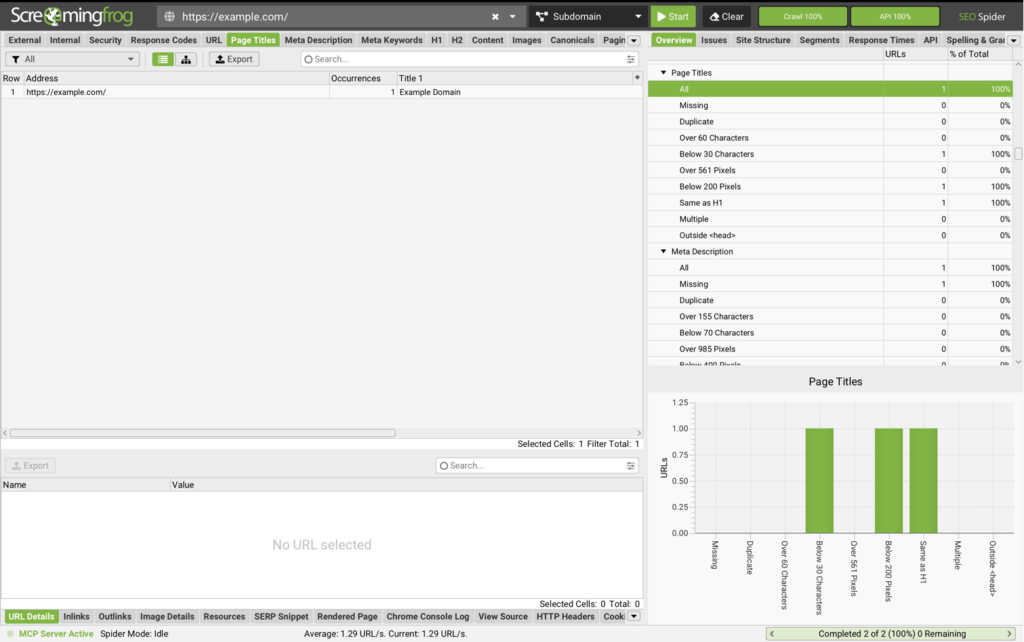
The licensed version renders pages in headless Chromium, crawling what JavaScript builds rather than only what the raw HTML contains, which is essential for auditing React, Vue, Angular, and other client-rendered sites.
- Parity with Google: rendering approximates how Googlebot processes a page, exposing content and links that exist only after script execution.
- Comparison views: rendered versus raw source comparisons help isolate what JavaScript adds or hides.
- Cost of rendering: rendered crawls are slower and heavier on hardware, a physics problem no crawler escapes.
Screaming Frog shipped JavaScript rendering before it was standard in the category, and it remains one of the strongest reasons the tool anchors technical audits: an audit that only reads raw HTML on a modern JavaScript site is auditing a page that users and search engines never see.
Beyond what the crawler reports by default, the extraction layer lets users define their own data.
Custom extraction and custom JavaScript
Custom extraction pulls any data from crawled pages using CSS Path, XPath, or regex, turning the crawler into a bulk scraping and analysis tool, and the custom JavaScript feature goes further by executing user-supplied snippets against pages during a crawl.
- Practical uses: extracting prices, stock status, author names, schema fields, or any repeating on-page element at site scale.
- Custom JS: vendor tutorials demonstrate generating JSON-LD schema at scale and even calling AI models against page content mid-crawl.
- Skill requirement: this is the feature set where the technical ceiling shows, since XPath and regex fluency are assumed.
This layer is where the tool stops being an auditor and becomes a general instrument, and it is a major reason experienced users renew year after year. It is equally the layer that pushes the learning curve rating down for everyone else.
The 2026 releases added a different kind of extensibility: intelligence layers on top of the crawl.
AI integrations, semantic analysis, and the MCP server
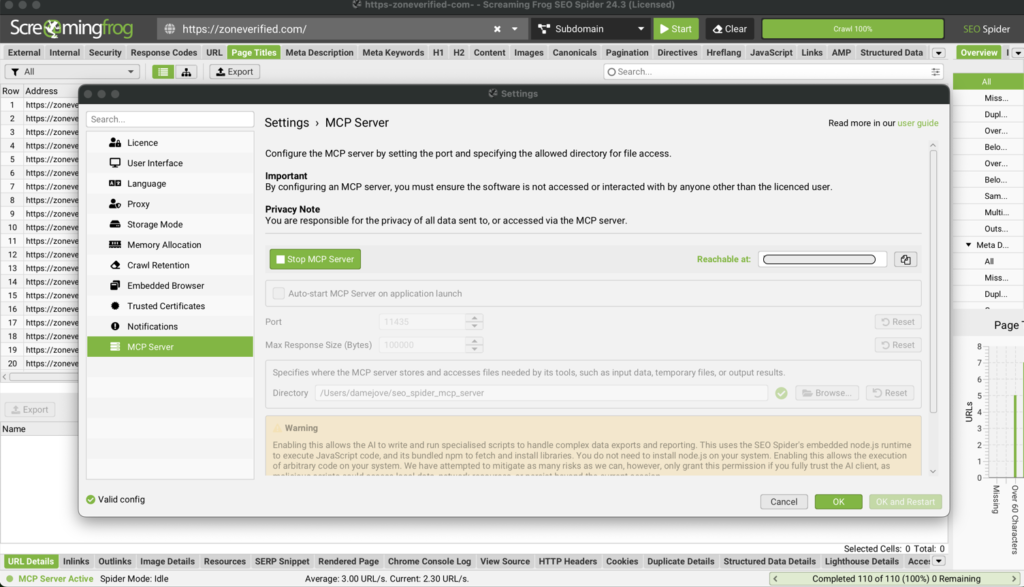
Version 22 introduced semantic similarity analysis and content cluster visualisations, using embeddings to evaluate how closely pages align with topics and to map a site’s content by meaning rather than keywords. Versions 21 through 24 built out direct integrations with OpenAI, Gemini, and Ollama, now with live model validation, system-wide prompts, and token-usage reporting. Version 24’s headline is the MCP server, which lets AI assistants run crawls, analyse and manipulate data, and export results through natural language.
- Semantic auditing: off-topic pages and weak content clusters are flagged by meaning, not string matching, a genuinely new lens for content pruning and topical-authority work.
- MCP in practice: the vendor demonstrates workflows from summarising crawl issues to combining crawl data with Ahrefs metrics into interactive link-equity visualisations.
- Current caveats: not every feature is MCP-supported yet, list mode notably, and early adopters hit a documented startup bug with the Claude extension that has a published fix.
The honest framing is that a fifteen-year-old desktop crawler is currently ahead of most cloud SaaS platforms in AI-agent integration, which is not the sentence anyone expected to write in 2026. The MCP server converts a famously manual tool into something automatable by non-programmers, and while it is early and imperfect, it is the most significant change to the product’s workflow story in years.
Automation existed before MCP, though, and the scheduled tooling matured meaningfully this year.
Scheduling, monitoring, and crawl comparison
Scheduled crawls and the command-line interface handle recurring audits, and version 24 connected the pieces into a monitoring loop: Auto Compare Crawls diffs the last two crawls in a project automatically, email notifications now carry the full issues table and comparison changes, and export files can be attached and sent on completion.
- Change detection: spikes in non-indexable pages, disappearing titles, or removed pages surface in the inbox without opening the application.
- Stakeholder routing: a weekly broken-links export can go straight to a developer, a summary to a stakeholder.
- Boundary: this is monitoring for practitioners, not an always-on enterprise platform with alerting SLAs; scheduled crawls also cannot yet be paused or cancelled mid-run.
For agencies and in-house teams, this turns a point-in-time audit tool into a standing early-warning system at no added cost, which strengthens the value case considerably.
The companion product completes the technical picture from the server side.
Log File Analyser and the wider toolkit
Screaming Frog also builds the Log File Analyser, a separately licensed desktop tool now at version 7.0, which parses server logs to show how search engine and AI bots actually crawl a site, the ground truth that complements the Spider’s simulation. Rounding out the Spider itself are XML sitemap generation, spelling and grammar checking, crawl visualisations including force-directed diagrams and the newer content cluster maps, and automated crawl reporting into Google’s Data Studio.
- Log analysis: the pairing of simulated crawl and real bot behaviour is the complete technical-SEO evidence set.
- Separate licence: the Analyser is not included in the Spider licence; its current pricing should be checked directly.
None of these are reasons to buy on their own, but together they mean a technical SEO can run an entire audit discipline on Screaming Frog tooling for less than a single month of a full-suite subscription.
Data Quality and Accuracy
Because data accuracy carries the heaviest weight in this rubric, the unusual shape of this tool needs stating plainly before scoring it: Screaming Frog maintains no keyword database, no backlink index, and no traffic model. It is a crawler. Its data is a direct, first-party measurement of the site being audited, collected on demand by the user’s own machine. That distinction matters for how this dimension applies, and readers deserve to see the reasoning.
The rubric asks whether a tool’s data can be trusted. For the platforms earlier in this series, that question meant interrogating modeled estimates against ground truth, because a database’s volumes and traffic figures are predictions. Screaming Frog’s crawl output is not a prediction. A 404 it reports is a 404; a missing canonical is missing; a redirect chain has exactly the hops shown. User consensus reflects this: across review platforms and practitioner communities the crawl data is described as the most accurate available, with reviewers noting that it precisely mimics Googlebot behaviour, and it is routinely the reference other tools’ audit findings are checked against. Freshness is structural rather than a database property, since data is as current as the last crawl the user chooses to run. The JavaScript rendering engine closes the largest historical accuracy gap in crawling, the difference between raw HTML and what a browser actually builds.
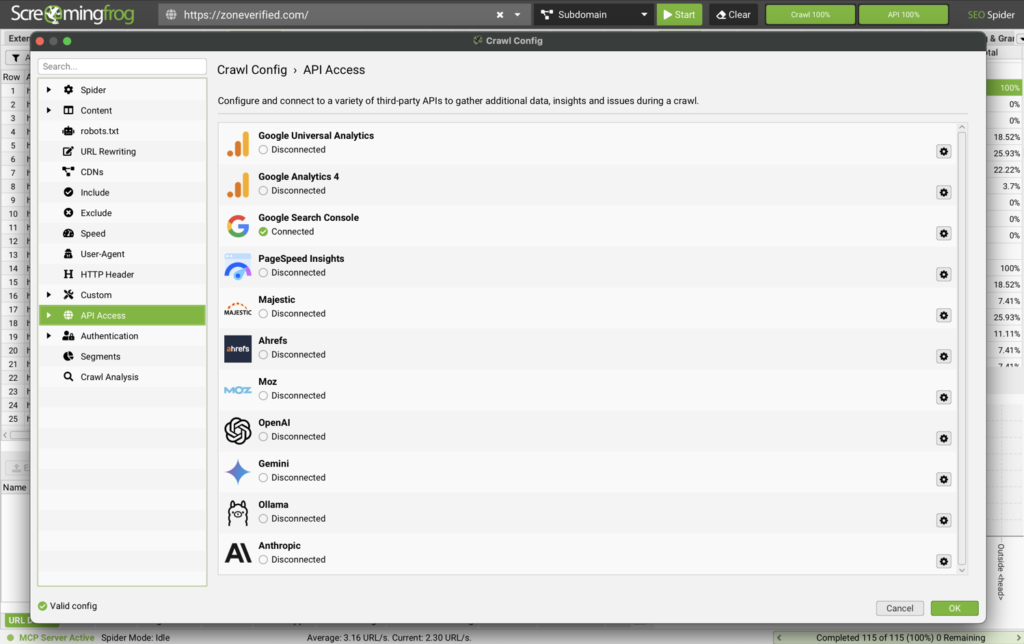
Two honest boundaries keep the score below the top of the scale. First, the dimension’s market-data sub-criteria simply do not apply: the tool supplies no search volumes, difficulty scores, traffic estimates, or rank tracking of its own, and where those numbers appear in a crawl they arrive through the Google Search Console, Analytics, Ahrefs, Majestic, and Moz integrations, inheriting those sources’ accuracy characteristics, which this series has covered elsewhere. A buyer whose accuracy concern is market data is asking about a product Screaming Frog does not sell. Second, completeness at extreme scale is hardware-dependent. The hybrid storage engine crawls very large sites, but the ceiling is set by the user’s memory and disk, not by a vendor’s cloud, and consensus includes recurring notes about resource intensity on big crawls.
The editorial conclusion, and the reason this dimension scores where it does: within its scope, Screaming Frog produces the most trustworthy data in this review series, because it measures instead of modeling. The score is held to 4.25 rather than higher only because the dimension also weighs the breadth of data a tool provides, and this tool deliberately provides none of the category’s market data, and because completeness on the largest crawls depends on the user’s hardware. That is a scope boundary honestly priced in, not an accuracy deficiency, and the review says so explicitly because the distinction is the entire buying decision.
Features
Assessed against the rubric’s feature sub-criteria, Screaming Frog is a study in asymmetry. Of the six capability areas the dimension names, keyword research, rank tracking, backlinks, site audits, competitor tools, and content tools, it fully serves one, site auditing, at a depth no suite’s built-in crawler matches, and it contributes to content work through the semantic analysis, duplicate detection, and spelling and grammar layers. Keyword research, rank tracking, and backlink analysis are absent by design, and competitor analysis extends only as far as crawling a competitor’s public site.
What the score rewards is meaningful differentiation, and here the tool has few peers in the entire category: 300-plus issue detection, JavaScript rendering, custom extraction and custom JavaScript, semantic similarity and content clustering, accessibility auditing, structured data validation, crawl comparison, scheduling with monitoring-grade notifications, a CLI, and the category’s first mainstream MCP server. Nothing is tier-gated, since one licence unlocks everything, and there are no credits or meters anywhere. A 4.0 reflects a tool that is the best in the category at its single job while covering a minority of the category’s total surface, the mirror image of the full suites reviewed earlier.
Ease of Use
Consensus on this dimension splits cleanly by audience, and both halves are well attested. Practitioners consistently describe the tool as fast and efficient once learned, with several reviewers on Capterra citing ease of use among its strengths for day-to-day technical work. The counterweights recur just as consistently: an interface that reviewers describe as dated and visibly unchanged in design philosophy since the early years, a volume of tabs, filters, and configuration options that overwhelms newcomers, a steep learning curve acknowledged across every review platform, and the memory and storage management that desktop crawling of large sites requires, which is a category of problem cloud users never meet.
The fair editorial read is that Screaming Frog is an instrument, and instruments assume an operator. It makes little effort to teach SEO to its user, and it exposes rather than hides complexity, which is precisely what its core audience wants and precisely what makes it the wrong first tool for a beginner. Extensive vendor tutorials and documentation shorten the ramp considerably, but do not remove it. A 3.25 places it below every suite in this series on this dimension, which matches how the market itself describes the tool.
Pricing and Value
Pricing is verified directly from Screaming Frog’s own pricing page and FAQ. The free version crawls up to 500 URLs per crawl with core auditing, no signup required, but without saved crawls, configuration, JavaScript rendering, custom extraction, or integrations. The licence costs £199, $279, or €245 per year, per user, and unlocks everything: no crawl limit beyond hardware, no per-site restrictions, no feature tiers, no credits. Bulk discounts apply from five licences, with third-party sources citing $265 per licence at five to nine, $249 at ten to nineteen, and $235 at twenty or more. Licences are annual only, revert the tool to the restricted free version on expiry, and can be transferred to a new user once per term. The vendor’s own FAQ notes just two price increases in the fifteen years since 2010, with the £199 base unchanged since 2023 and the May 2025 change a currency adjustment on the dollar and euro figures only.
The comparative arithmetic is stark and drives the score. At roughly $23 per month, the licence costs less than a tenth of a Semrush Pro or Ahrefs Lite subscription, and dedicated cloud crawlers position several multiples higher again. Against that, user consensus on value is about as close to unanimous as this series has recorded, with the recurring dissent limited to occasional users who wish a monthly option existed and very small site owners for whom the free tier already suffices. The honest counterweights are structural: per-user licensing scales linearly for teams, the tool covers only part of an SEO stack so its price is additive to whatever provides keywords and links, and there is no monthly billing. A 4.75 records the strongest value proposition in this series while leaving room for those real limits.
Integrations
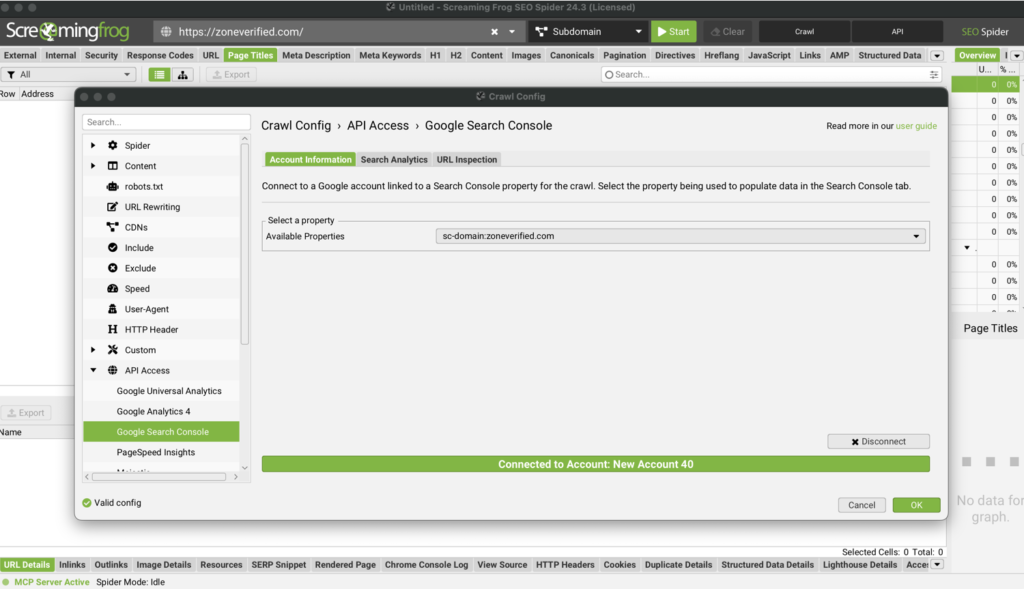
For a desktop application, the integration surface is unexpectedly broad and unusually current. Crawls can be enriched with Google Search Console data including URL Inspection, Google Analytics 4, and PageSpeed Insights, and with link and keyword metrics from Ahrefs, Majestic, and Moz for users holding those subscriptions. The AI layer connects directly to OpenAI, Gemini, and local models through Ollama. Automated crawl reports feed Google’s Data Studio, and the MCP server now exposes the crawler to AI assistants, with the vendor’s own demonstrations combining crawl and Ahrefs data into custom visualisations.
The boundaries are the desktop format’s. There is no public REST API; programmatic automation runs through the command-line interface and now MCP, which covers most practitioner needs but not server-side product integration. Everything executes on the user’s machine, so integrations enrich local crawls rather than feeding a cloud pipeline. Within those limits, and crediting the MCP server as a genuine category first for a desktop tool, a 4.25 is earned.
Customer Support
Support runs through email and a ticket system, with no live chat or phone channel, and consensus rates it well. Reviewers describe responses as knowledgeable and human, the company provides technical support to licensed users as part of the flat fee, and the founder visibly answers user questions in release-post comments, including bug triage and workarounds, a small but telling signal of how close the team sits to its users. The self-service layer is strong: an extensive user guide, a large tutorial library covering everything from broken-link checking to web scraping and accessibility audits, an issues library explaining every check, and active release documentation.
The limits are those of a small company in one time zone: no 24/7 coverage, no premium support tier, and channel choice restricted to written contact. Nothing in consensus resembles the billing and refund friction documented for the larger platforms in this series. A 4.0 reflects dependable, well-documented support without enterprise trappings.
Security
Screaming Frog’s security posture is unusual in this series because the architecture itself does most of the work. As a desktop application, crawl data is collected and stored on the user’s own machine rather than in a vendor cloud, so the sensitive asset in most SEO workflows, the crawl of a client’s site, never leaves the user’s control unless the user configures integrations that send it somewhere. The vendor’s release notes provide direct, verifiable evidence of active security maintenance, including a June 2026 dependency update explicitly shipped to fix several CVEs, and the update cadence across 2026 shows rapid patch releases. Screaming Frog Ltd is a UK company subject to UK GDPR, with a published privacy policy covering its site and services.
The boundaries of this assessment are honest ones: no SOC 2 or ISO 27001 attestation was identified, which is unsurprising and of limited relevance for locally run desktop software, and the privacy policy and payment-processing arrangements for licence purchases should be read directly on publish day, as flagged in the fact-check list.
Security gate: Pass, posture-based. The local-first architecture, vendor-published CVE patching, and UK regulatory context together clear ZoneVerified’s standard, with direct verification of the privacy documentation required before publication.
Software Specifications
The grid below is a verified reference that supports the narrative above; it does not replace it. Marks reflect Screaming Frog’s own documentation. A green check means a capability is present in the licensed version, with notable conditions in the label. A grey cross means the capability is genuinely absent.
Final Verdict
Final Verdict
Screaming Frog’s 4.1 is the highest score in this review series, and it is worth being precise about why a single-purpose desktop tool outscores three full-suite platforms on a rubric built for the whole category. The answer sits in the two heaviest dimensions. Data Quality at 4.25 records the only tool in the series whose data is measured rather than modeled, crawl output the industry itself treats as ground truth, with the score’s ceiling set honestly by what the tool does not attempt rather than by anything it gets wrong. Value at 4.75 records a flat $279 per year against suite subscriptions running five to fifteen times that, a functional free tier, no feature gating, no credits, and a fifteen-year pricing history with two increases, a value consensus as close to unanimous as this series has seen.
The counterweights are equally clear and keep the score grounded. Ease of Use at 3.25 is the lowest in the series, reflecting an instrument built for operators who already know their craft, delivered in an interface nobody defends aesthetically, on a desktop-only model that makes the user responsible for hardware. Features at 4.0 records unmatched depth across a deliberately narrow slice of the category, and the surrounding dimensions reflect a small company doing focused things well: an integration surface that now includes a category-first MCP server, and support that is modest in channels but strong in substance.
The recommendation is therefore unusually clean. For anyone doing serious technical SEO, Screaming Frog is close to non-optional, and at its price the question is not whether it earns a place in the stack but only what sits alongside it. For anyone who needs the rest of the stack, keywords, rankings, links, in one product, it is not a candidate, and the three 3.9-scoring suites in this series are where that decision lives. Judged for what it is, the most trusted measurement instrument in the discipline at a price that undercuts everything comparable, it earns the top of this series on the evidence.
Alternatives
- Semrush. The broadest full suite in the category, whose built-in Site Audit covers routine crawling needs for teams that do not require Screaming Frog’s depth, alongside the keyword, backlink, and competitive data Screaming Frog does not provide. Reviewed at 3.9 in this series.
- Ahrefs. The data-accuracy leader among the full suites, with a capable site audit and the backlink index that pairs naturally with Screaming Frog through its direct integration. Reviewed at 3.9 in this series.
- SE Ranking. The value pick among the suites, whose audit tooling covers most agency workflows at a bundled price, best where one affordable platform must do everything adequately. Reviewed at 3.9 in this series.
- Sitebulb. The nearest direct competitor as a dedicated desktop and cloud crawler, generally regarded as more approachable and more visual, at a higher subscription price and with less raw configurability.
About the Author

Mademoiselle Jove, Senior Editor, ZoneVerified
Mademoiselle Jove is the Senior Editor at ZoneVerified. With over eight years of professional experience in SEO, technical SEO, content strategy, and digital marketing, she specializes in evaluating software through the lens of real business workflows. Her experience includes building SEO systems, managing large-scale content operations, conducting technical audits, and working with a wide range of productivity, analytics, marketing, and project management tools. She oversees ZoneVerified’s editorial standards to ensure every review is accurate, transparent, and genuinely useful.
Editorial Independence: ZoneVerified publishes independent reviews based on research, editorial analysis, and genuine hands-on experience where applicable. Our recommendations are never influenced by compensation or commercial relationships.