
Semrush is an all-in-one online visibility platform built around search engine optimization, with adjacent toolsets for paid search, content marketing, social media, local SEO, competitive research, and, more recently, AI search visibility. It sits in the SEO-tools category alongside Ahrefs, Moz, SE Ranking, and Similarweb, and it optimizes for one thing above all: breadth. Where most competitors lead with a single strength, Semrush packages keyword research, rank tracking, backlink analysis, site auditing, and competitor intelligence into one workspace and surrounds it with marketing tools that reach well past classic SEO.
In late 2025 the company restructured part of its lineup around “Semrush One,” a bundle that pairs the SEO toolkit with a new AI Visibility toolkit, and in April 2026 it was acquired by Adobe and now operates as a wholly owned Adobe subsidiary. This review covers the platform as it stands in 2026: what its data is built from, how that data holds up against ground truth, what the toolset actually includes, and where the price and the learning curve become the real decision points.
The deepest, broadest dataset and toolset in the category, held back from a higher mark by premium pricing, heavy feature gating, and a learning curve that punishes newcomers.
Agencies, in-house teams, and serious practitioners running SEO alongside content, PPC, and AI-visibility work who will use the breadth daily.
You are a solo blogger or small business on a tight budget, or you need one focused tool rather than a sprawling suite.
Every ZoneVerified review follows the same evidence-first editorial process. Wherever we have genuine access to a tool, we test it ourselves, then support our findings with official documentation and recurring user consensus, and clearly distinguish first-hand experience from research-based conclusions.
Our ratings are independent and reflect our editorial assessment of each product alone. Commercial relationships never determine how software is reviewed, scored, or recommended, and our conclusions are never influenced by affiliate partnerships. Learn more about our Transparency Policy and Software Review Methodology.
What’s New in 2026
A few changes since prior coverage are material to a buying decision, and one is structural.
- Adobe ownership. Adobe completed its roughly $1.9 billion acquisition of Semrush on 28 April 2026, and Semrush now operates as a wholly owned Adobe subsidiary, delisted from the NYSE. Semrush states there are no immediate changes to services, agreements, billing, or support. The longer-term direction points toward tighter integration with Adobe’s customer-experience products and a heavier emphasis on AI search visibility.
- Semrush One bundle. Introduced in late 2025, Semrush One pairs the classic SEO toolkit with the new AI Visibility toolkit in three tiers, with published list prices of $199 (Starter), $299 (Pro+), and $549 (Advanced) per month. The classic Pro, Guru, and Business plans continue alongside it.
- AI Visibility toolkit. A paid module, listed at $99 per month per domain standalone, tracks how a brand appears in answers from ChatGPT, Gemini, Perplexity, SearchGPT, and Google AI Mode and AI Overviews. Per Semrush’s documentation it collects and refreshes more than 289 million prompts monthly.
- Semrush Copilot. A free in-platform AI assistant that surfaces personalized recommendations across the toolkit.
- AI-aware rank tracking. Position Tracking can now monitor visibility for target prompts in ChatGPT and Google AI Mode, in addition to Google, Bing, and Baidu organic positions.
- Classic pricing held steady. Pro, Guru, and Business list prices are unchanged at $139.95, $249.95, and $499.95 per month.
Software Overview
Semrush is the broadest SEO and digital-marketing platform on the market, built on what is, by the company’s own published figures, the largest dataset in the category. According to Semrush’s documentation, the platform spans 142 geographic databases and holds over 27.9 billion keywords, 808 million domain profiles, and 43 trillion backlinks, with its crawler processing roughly 10 billion pages a day. That scale anchors a toolset of more than fifty tools across SEO, content, PPC, social, local, competitive research, and AI visibility. The trade-offs that follow are about price, complexity, and how much of that breadth a given buyer will genuinely use.
- ✓Category-leading data scale and freshness, with the largest published keyword and backlink databases and frequent refresh cycles
- ✓The widest toolset in the category, capable of replacing several separate subscriptions for teams that use it fully
- ✓Strong keyword research and competitor intelligence, consistently rated best-in-class by active users
- ✓Early, credible coverage of AI search visibility across major LLM answer engines
- ✓Excellent self-service education, including a free Academy with recognized certifications
- −Premium pricing, with a single seat by default and add-ons that can quietly multiply the bill
- −Heavy feature gating, with content tools and historical data on Guru and above and API access on Business only
- −Steep learning curve, with a dense dashboard that overwhelms beginners and solo owners
- −Traffic estimates are modeled and can diverge from Google Search Console, with accuracy dropping on smaller sites
- −Recurring complaints about billing, refunds, and cancellation friction on consumer review platforms
The Trade-Off
The single exchange Semrush asks a buyer to make is breadth and depth of data in return for cost and complexity. You get more tools, more keywords, and more backlinks than anywhere else, and in return you pay a premium price, accept that much of the value sits behind upgrades and add-ons, and invest real time before the platform feels productive. For a team that lives in the tool daily and spans SEO, content, and paid work, the exchange is easy to justify. For a solo user who needs a narrow slice, it rarely is.
Who It’s Best For
Semrush fits agencies and in-house marketing teams that run integrated programs across SEO, content, PPC, and increasingly AI visibility, and that have the budget for a Guru-tier subscription and the staff to absorb the learning curve. It rewards practitioners who use competitive intelligence and keyword research heavily, who manage multiple projects, and who benefit from consolidating several point tools into one platform. Buyers who value analyst recognition and broad review-platform consensus during procurement will also find Semrush well represented.
Who Should Look Elsewhere
Solo bloggers, very small businesses, and anyone on a tight budget will likely find Semrush expensive relative to what they will use, and beginners often feel lost in the interface. Teams that need one focused capability rather than a suite, or that work substantially outside Google, may be better served by a leaner or more specialized tool. SE Ranking, for example, is frequently cited as roughly half the price with a gentler interface, and Ahrefs is often preferred where backlink depth or rank-tracking value at scale is the priority.
Grounded in years of hands-on SEO work, SEO tools are only as reliable as the data behind them, so data quality and accuracy carries the most weight — a tool that reports the wrong numbers is more harmful than one that simply does less.
Whether the data can be trusted: index and database size and freshness, and the accuracy of search volumes, keyword difficulty, traffic estimates, and rank tracking, checked against real data such as Google Search Console where possible.
Depth across keyword research, rank tracking, backlinks, site audits, and competitor and content tools, how well they connect, and what’s gated to higher tiers or metered by credits.
How quickly a user becomes productive in daily use, with dashboards that surface insight rather than bury it.
What the tool delivers against its cost, including how price scales with usage limits and credits, judged against realistic alternatives.
How well it connects to the rest of an SEO stack — Search Console, Analytics, Google Ads, Looker Studio — through native integrations and an API.
Documentation, learning resources, and direct help, and how that shifts across tiers.
Security posture, certifications where applicable, privacy, data handling, and access controls, verified against the vendor’s trust documentation. A tool that falls short is flagged regardless of how it scores elsewhere.
How overall scores are calculated. Scores are assigned dimension by dimension before the overall rating is calculated using the fixed weights above, never adjusted to reach a preferred outcome. Every review states plainly where a judgment rests on first-hand testing versus official documentation and user consensus.
Read our complete software review methodology.
Core Features
Semrush’s defining characteristic is the way a very large dataset feeds an unusually wide set of tools. The sections below cover the capabilities that matter most to an SEO buyer. They are organized by what each tool does, what stands out, and what it means in practice, rather than as a feature roll-call.
Keyword research (Keyword Magic and Keyword Overview)
Keyword research is Semrush’s most recognized strength, and it rests on the largest keyword database in the category. The Keyword Magic Tool draws on a global index that Semrush’s documentation puts at over 27.9 billion keywords across 142 geographic databases, which makes deep long-tail discovery and intent filtering practical in most niches.
- Database scale: the breadth surfaces long-tail and question-based terms that thinner indexes miss.
- Metrics per keyword: volume, keyword difficulty, CPC, intent, trend, and SERP features.
- Personalized difficulty: a difficulty metric that can factor in your own domain’s authority rather than a generic score.
- Practical limit: search volume is a modeled estimate, not a direct read from Google.
Across independent review platforms, the keyword tools are the capability users praise most often, frequently described as the most useful part of the platform for discovery and content planning. The editorial point worth making is that scale and discovery are not the same as precision. The database is excellent for finding and prioritizing opportunities, and Semrush’s own benchmarking suggests its volume figures track Google reasonably well, but the numbers should be read as well-sourced estimates for relative comparison rather than exact counts. That distinction matters most on low-volume terms, where divergence from real data widens.
This naturally raises the question of how Semrush’s wider dataset performs against ground truth, which is the heart of any SEO-tool assessment.
Backlink analytics and audit
Backlink analysis is the other pillar of Semrush’s data story. The company reports a database of over 43 trillion backlinks fed by a crawler that processes roughly 10 billion pages a day, with link data refreshed on a near-continuous cadence.
- Index size and freshness: among the largest and most frequently updated link indexes available.
- Use cases: competitor link profiling, link-building prospecting, and toxic-link auditing.
- Referring domains: large referring-domain coverage for gap analysis.
In editorial terms, the backlink toolset is genuinely competitive with the historical category leader on raw index size, and the refresh frequency is a real advantage for monitoring new links. The caveat common to every link tool applies: no crawler sees the entire web, so counts differ between platforms, and link data is best treated as directional. For most teams the combination of scale, freshness, and toxic-link scoring is more than sufficient for day-to-day link work.
From individual links the platform moves outward to whole-site health, which is where Site Audit comes in.
Site Audit and on-page tools
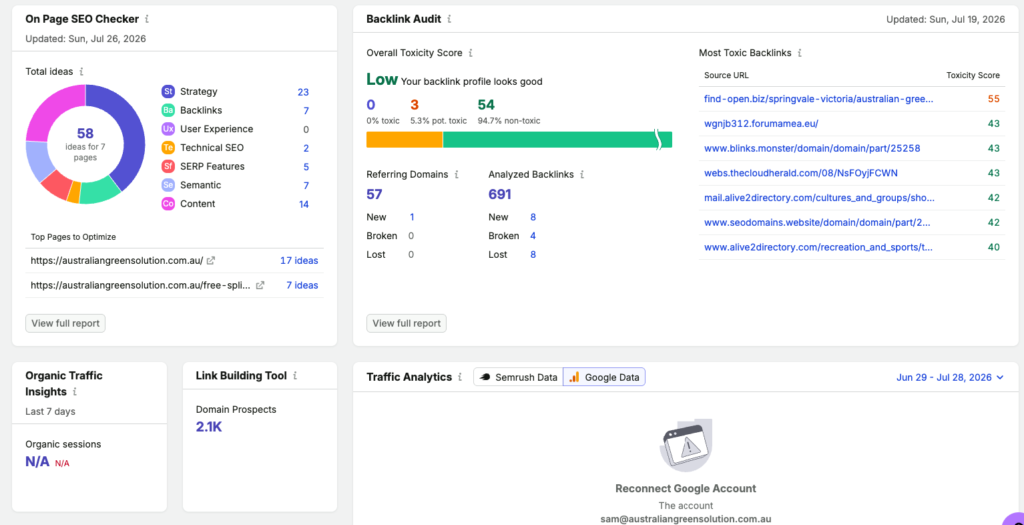
Site Audit crawls a property and reports technical and on-page issues, scoring overall site health and grouping problems by severity. On Page SEO Checker layers in prioritized optimization ideas tied to a project’s target keywords.
- Crawl coverage: a broad set of technical checks across errors, warnings, and notices, with crawl budgets that scale by plan.
- AI-readiness: newer checks assess whether AI crawlers can access content.
- Workflow: issues link to guidance and can be tracked over time.
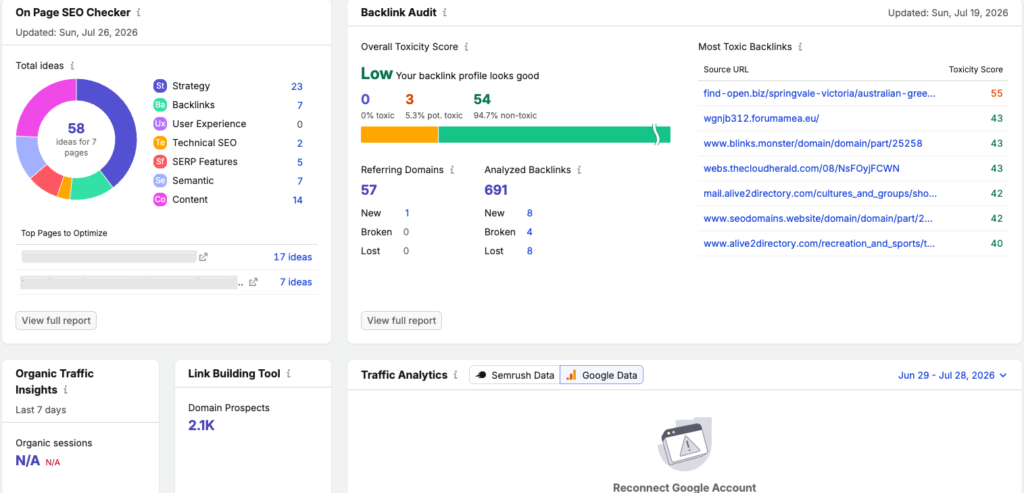
The audit tooling is solid and clearly presented, and the move to flag AI-crawler access reflects where search is heading. It is not the single deepest technical crawler on the market for very large sites, where dedicated crawlers go further, but for the majority of properties it covers the issues that actually move rankings. Site health scores can fluctuate, which some users find noisy, so the trend matters more than any single reading.
With a site’s own health mapped, Semrush’s competitive tools turn the same data outward to rivals.
Competitor and domain analysis
Domain Overview, Organic Research, and Keyword Gap let a user profile any domain’s organic and paid footprint, then compare it against competitors to find content and keyword gaps.
- Competitor discovery: surfaces rivals a user may not have known were competing for the same terms.
- Gap analysis: highlights keywords competitors rank for that a site does not.
- Paid visibility: estimates competitors’ Google Ads activity alongside organic data.
This is one of the platform’s strongest practical capabilities, and across user consensus competitive intelligence is repeatedly cited as a reason teams choose Semrush over narrower tools. The editorial qualification is that competitor traffic and position figures are estimates drawn from the same modeled data discussed in the accuracy section below, so they are best used to rank and compare rather than to report exact rival traffic.
Beyond research, Semrush also tries to help teams act on what they find, which is the role of the content toolkit.
Content marketing toolkit
Available on Guru and above, the Content Marketing toolkit includes Topic Research, the SEO Content Template, the SEO Writing Assistant, Content Audit, and the AI-assisted ContentShake. Together they move a user from topic discovery to optimized drafting inside one platform.
- End-to-end flow: from topic gaps to briefs to on-page optimization scoring.
- AI assistance: ContentShake and the Writing Assistant support drafting and optimization.
- Gating: the full toolkit requires a Guru upgrade.
For content-led teams this toolkit is often the feature that justifies the Guru tier, since it can reduce the need for a separate content-optimization subscription. It is capable rather than category-defining against specialized content tools, but its value lies in living next to the keyword and competitor data rather than in any single standout feature.
The newest and most strategically significant addition addresses where discovery itself is shifting.
AI Visibility toolkit
The AI Visibility toolkit tracks how a brand appears in answers from ChatGPT, Gemini, Perplexity, SearchGPT, and Google AI Mode and AI Overviews, scoring visibility, sentiment, share of voice, and cited sources.
- Coverage: multiple major answer engines, with prompt-level tracking.
- Data scale: Semrush’s documentation cites more than 289 million prompts refreshed monthly.
- Cost: a paid add-on at a listed $99 per month per domain, or bundled within Semrush One.
This is a credible, early entry into a category that is still forming, and it is clearly central to Adobe’s rationale for the acquisition. Honest framing matters here: AI visibility is a secondary capability bolted onto a mature SEO platform rather than a purpose-built tool, it covers fewer models than some dedicated competitors, and on smaller domains the prompt data can be thin. For existing Semrush customers who want AI-answer tracking next to their keyword data, it is convenient. For teams whose primary need is AI visibility, a specialized tool may go deeper.
Rounding out the suite are the local, advertising, and social tools.
Local, advertising, and social
Semrush extends past core SEO with a Local toolkit for listings management and map rank tracking, an Advertising toolkit and the AdClarity app for PPC and competitive ad research, and a Social toolkit for scheduling and analytics across major networks.
- Local: listing distribution and geo-grid rank tracking, sold partly as a per-location add-on.
- Advertising: Google Ads research backed by a large ad creative database with history to 2012.
- Social: publishing and analytics drawn from public network APIs.
These rounding-out tools are where the all-in-one promise is strongest and weakest at once. They are good enough to consolidate several light subscriptions for a team that wants one bill, but each is generally less deep than a dedicated specialist. Their value is contextual, sitting beside the SEO data, rather than reasons to buy Semrush on their own.
Data Quality and Accuracy
Because data accuracy carries the most weight in this category, it deserves the closest look. Semrush’s case rests on two things: the size and freshness of its databases, and how closely its estimates track reality.
On scale and freshness, the evidence is strong and comes straight from Semrush’s documentation. The platform spans 142 geographic databases and reports over 27.9 billion keywords, 808 million domains, and 43 trillion backlinks, with keyword data refreshed on a cadence that ranges from daily for popular terms to roughly monthly for the long tail, and backlink data refreshed near-continuously. Traffic and market data is modeled from a clickstream panel that Semrush describes as more than 200 million anonymized users across over 190 countries. As a verified fact, this is the largest published dataset in the category, and freshness is a genuine competitive advantage.
On accuracy, the picture is more nuanced and depends on which metric you mean.
- Search volume. All SEO tools model search volume rather than reading it directly, so figures differ between platforms and from Google. A Semrush-funded 2022 study, benchmarked against anonymized Google Search Console data for the US, reported Semrush as the closest to actual figures about 32 percent of the time, ahead of Google Keyword Planner, Moz, and Ahrefs. That result is worth knowing but should be read with caution, since it was conducted by the vendor and compares a twelve-month average against exact monthly data. Independent commentators consistently describe search volume across all tools as a rough guide rather than a precise count.
- Keyword difficulty and CPC. These generally align reasonably with Google Ads sourcing, and Semrush’s personalized difficulty option is a useful refinement, but they remain estimates.
- Traffic estimates. This is Semrush’s clearest relative weakness. An independent 2024 study by Collaborator compared Ahrefs, Similarweb, and Semrush against Google Search Console across 184 websites and found Semrush had the highest average error of the three, around 62 percent, with a tendency to overestimate traffic, against roughly 57 percent for Similarweb and about 49 percent for Ahrefs. Across all three tools, accuracy dropped sharply for sites under about 5,000 monthly clicks. User consensus echoes this, with some reviewers reporting volume discrepancies and occasional zero-volume readings in Position Tracking that diverge from Google’s own figures.
The editorial conclusion is that Semrush’s data is best understood as exceptionally broad, fresh, and reliable for discovery and relative comparison, especially in keyword research and backlinks, while its absolute traffic estimates should be treated as directional and cross-checked against a site’s own analytics, particularly for smaller properties. For the decisions most SEO teams actually make, prioritizing keywords, profiling competitors, and finding link and content gaps, the data is dependable. For reporting precise traffic numbers, it is not a substitute for Google Search Console.
Features
Assessed as a toolset, Semrush leads the category on breadth and holds up well on depth. The platform spans more than fifty tools covering keyword research, rank tracking across Google, Bing, and Baidu, backlink analytics and audit, site audit, on-page optimization, competitor and gap analysis, the content marketing toolkit, local, social, advertising, the AI Visibility toolkit, the free Copilot assistant, and an App Center ecosystem. Few competitors match this range, and several of the individual tools, notably keyword research and competitor intelligence, are strong enough to compete on their own merits rather than only as part of a bundle.
The honest qualification is that breadth is heavily tier-gated. The Content Marketing toolkit and historical data require Guru, API access is reserved for Business, Looker Studio connectors require Guru or above, and the AI Visibility toolkit and several other capabilities are paid add-ons or metered. A capability locked behind an upgrade is not the same as one included, and the gating is aggressive enough that the headline tool count overstates what any single plan delivers. Even so, judged on meaningful differentiation rather than feature parity, the toolset is the most complete in the category.
Ease of Use
This is where Semrush most clearly pays for its breadth. The most consistent theme across user consensus, on G2 and Capterra alike, is a steep learning curve and a dense, feature-heavy dashboard that beginners and solo business owners describe as overwhelming. Reviewers regularly note feeling lost among fifty-plus tools and needing weeks to find their way. The same reviewers, once past that curve, tend to describe the platform as clean, fast, and rewarding, and some find the interface intuitive from the start.
The fair editorial read is that Semrush is built for practitioners, not newcomers. Its defaults, templates, and documentation help, and Copilot lowers the barrier somewhat, but the sheer surface area works against quick productivity. Teams with SEO experience will adapt; individuals new to the discipline should expect a real ramp.
Pricing and Value
Semrush publishes three classic tiers. Pro lists at $139.95 per month, or about $117.33 per month billed annually, and includes 5 projects, 500 tracked keywords, and core SEO tools, but no content toolkit, historical data, or multi-location tracking. Guru lists at $249.95 per month, or about $208.33 annually, and adds the Content Marketing toolkit, historical data, multi-location tracking, Looker Studio connectors, and higher limits at 15 projects and 1,500 keywords. Business lists at $499.95 per month, or about $416.66 annually, and adds API access, Share of Voice, and the highest limits at 40 projects and 5,000 keywords. Annual billing saves roughly 17 percent. The separate Semrush One bundle pairs the SEO and AI Visibility toolkits from a listed $199 per month.
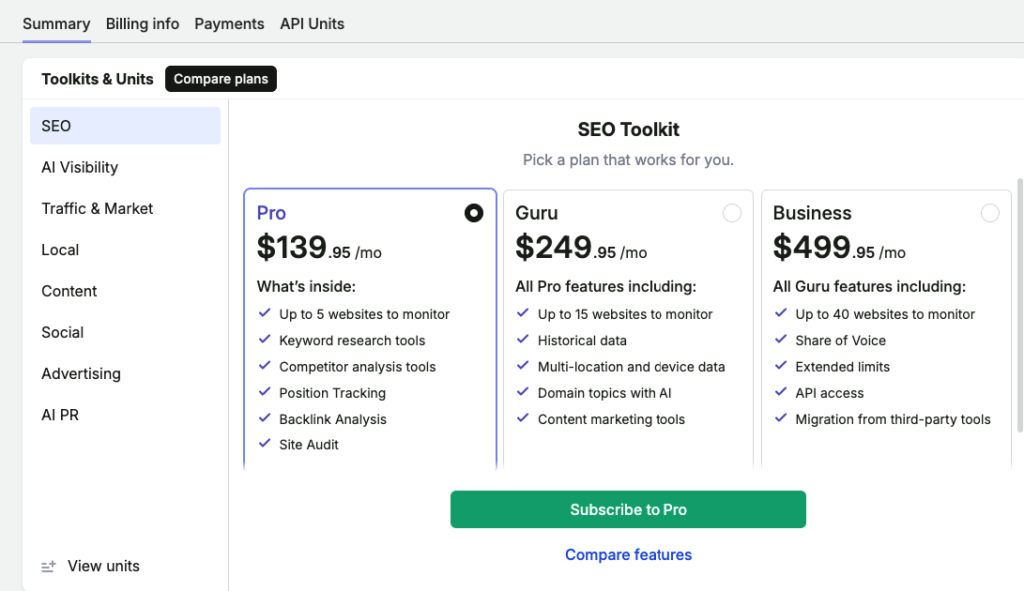
The cost story does not end at the headline. Plans include a single user seat by default, with additional seats listed at $45, $80, and $100 per month on Pro, Guru, and Business respectively, so a small team’s real cost can be well above the sticker. Add-ons compound it further: the .Trends market-analysis module is listed at $289 per month, the AI Visibility toolkit at $99 per month per domain, and Local at a per-location rate. User consensus frequently describes the pricing as “nickel and dime.”
There is also a recurring trust signal worth weighing here. While active users on G2, Capterra, and TrustRadius rate the product highly, consumer-focused platforms tell a harsher story: Trustpilot scores sit far lower, in the low single digits, and Semrush carries a poor Better Business Bureau rating tied to unresolved complaints, with multiple reviewers reporting denied refunds and difficulty cancelling. There is no self-serve cancellation button in the dashboard. Read together, the product earns its keep in daily use while the purchase and renewal experience carries real friction.
On value, the verdict splits cleanly by buyer. For an agency or team that uses the breadth daily and would otherwise pay for several separate tools, Semrush can be strong value despite the price. For a solo user or small business, it is expensive relative to what they will use, and capable cheaper alternatives such as SE Ranking exist at roughly half the cost.
Integrations
Semrush connects to the core of a typical SEO stack. It integrates natively with Google Search Console and Google Analytics 4, pulls and pushes Google Ads data, manages Google Business Profile listings, and offers Looker Studio connectors for Domain Analytics, Position Tracking, and Site Audit. A developer API supports custom dashboards and reporting, and the App Center and newer AI connectors extend the platform further.
The qualification is, again, gating. The Looker Studio connectors require a Guru or Business subscription, and API access is exclusive to the Business tier, which puts programmatic integration out of reach for most lower-tier buyers. Within those limits the coverage is broad and hits the connections most SEO teams depend on, which keeps this a clear strength even with the tier restrictions.
Customer Support
Support divides into two halves. On self-service, Semrush is excellent: an extensive knowledge base, a large library of tutorials and webinars, and a free Academy with recognized certifications mean most users can get unstuck without raising a ticket, and user consensus reflects that. On direct, human support, the signal is weaker. Recurring complaints describe slow or unhelpful responses, AI-generated email replies that are not clearly disclosed, and the refund and cancellation friction noted above, including unresolved Better Business Bureau complaints. Direct support availability also shifts with plan tier.
The balanced read is that documentation and education are genuine strengths, while human support and account handling are inconsistent enough to count against the dimension.
Security
Assessed against Semrush’s own trust documentation, the platform demonstrates a solid security posture. It encrypts data in transit using TLS 1.2 or higher, restricts personal data to role-based, need-to-know access, requires VPN access to company resources, and uses Google IAP for access control. Infrastructure and application activity is logged and forwarded to a SIEM tool for monitoring, development follows a secure software development lifecycle that includes design review, code review, and penetration testing, and staging and testing environments are logically separated with no production personal data. Hosting runs on reputable cloud providers, including AWS and GCP, whose data centers carry their own compliance certifications. On privacy, Semrush states adherence to GDPR, provides a data processing agreement, and monitors regimes such as CCPA and LGPD.
One caveat applies. We could not confirm a Semrush-held SOC 2 Type II or ISO 27001 certification on its public trust documentation; the posture is described in detail and relies in part on its cloud providers’ certifications. Under ZoneVerified’s posture-based standard, a strong vendor can pass without holding every enterprise certification, and Semrush’s documented controls clear that bar.
Security gate: Pass. Verify on publish day whether a current SOC 2 or ISO 27001 attestation now exists, as Adobe ownership may strengthen the formal certification posture.
Software Specifications
The grid below is a verified reference that supports the narrative above; it does not replace it. Each mark reflects Semrush’s documentation. A green check means a capability is present, including where it is gated to a higher tier or sold as an add-on, with the gating noted in the label. A grey cross means the capability is genuinely absent.
Semrush Specifications
Final Verdict
Final Verdict
Semrush remains the most complete SEO and digital-marketing platform a buyer can choose in 2026, and the score reflects exactly that profile: a category-leading dataset and toolset that perform strongly where it matters most, paired with real friction around cost, complexity, and the buying experience. The data is its anchor. The largest published keyword and backlink databases, refreshed often, make discovery, competitor profiling, and link work dependable, and that strength carries the most heavily weighted dimension. The qualification is honest and specific: traffic estimates are modeled, run higher than independent benchmarks against Google Search Console, and should be cross-checked rather than reported as fact, especially on smaller sites.
Everything else follows from breadth. The toolset is wider than any rival’s and deep enough in keyword research and competitive intelligence to stand on its own, but much of it sits behind Guru and Business tiers and add-ons, and the learning curve is steep enough that newcomers should expect a ramp. The price is premium, the single-seat default and add-ons inflate the real cost, and the gap between high product satisfaction among active users and persistent billing and cancellation complaints on consumer platforms is a genuine consideration. Security clears the gate on a well-documented posture.
The result is a platform that is easy to recommend to the buyer it was built for, an agency or team that will use the breadth daily and treat the subscription as infrastructure, and easy to caution against for the solo user or small business who would pay a premium for tools they will not touch. Used with its data read as directional rather than absolute, Semrush earns its standing at the top of the category.
About the Author

Mademoiselle Jove, Senior Editor, ZoneVerified
Mademoiselle Jove is the Senior Editor at ZoneVerified. With over eight years of professional experience in SEO, technical SEO, content strategy, and digital marketing, she specializes in evaluating software through the lens of real business workflows. Her experience includes building SEO systems, managing large-scale content operations, conducting technical audits, and working with a wide range of productivity, analytics, marketing, and project management tools. She oversees ZoneVerified’s editorial standards to ensure every review is accurate, transparent, and genuinely useful.
Editorial Independence: ZoneVerified publishes independent reviews based on research, editorial analysis, and genuine hands-on experience where applicable. Our recommendations are never influenced by compensation or commercial relationships.